Reflections of a Retiring Radiation Oncologist with Dr. Mark Storey
Episode Summary
In this special episode of The Cancer Project, Dr. Mark Storey rejoins host David Raubach to reflect on his seven years at the Oklahoma Proton Center and the next chapter of his career. Dr. Storey arrived at OPC in 2019 with a clear mission: advance proton therapy while improving both patient outcomes and the overall patient experience in radiation oncology. After 25 years of clinical practice and 30 years since earning his medical license, he describes what he calls “a midlife crisis gone well” and shares what this chapter of his career has meant to him.
The conversation covers the early days of OPC’s acquisition and reopening, including the uncertainty of buying a shuttered proton center, operating through four months without revenue, and then navigating the isolation and single-points-of-failure challenges of COVID as a two-oncologist facility. Dr. Storey reflects on the culture built around a guiding principle he returns to throughout the episode: treat every patient the way you would want your own family treated.
Dr. Storey offers a detailed look at where proton therapy holds the strongest clinical evidence today, citing pediatric cases, head and neck cancers, esophageal cancer, and left-sided breast cancer as areas where proton therapy’s ability to reduce radiation to healthy tissue translates into meaningful patient outcomes. He emphasizes that quality of life metrics like feeding tube rates, hospitalization days, and the ability to eat solid foods are patient-relevant gains that deserve more weight in treatment decisions.
The episode closes with Dr. Storey discussing his Substack, Protons 101, and his three-part series “The Approaching Singularity,” which examines the future of radiation oncology in the context of AI, evolving reimbursement pressures, and the need for the next generation of radiation oncologists to diversify their skills. His advice to younger physicians is practical and direct: measure your own results, don’t assume you’re in the top tier without evidence, and never stop advocating for the proven value of radiation in cancer care.
What You’ll Learn in This Episode
- Rebuilding a Proton Center: Dr. Storey describes the risk and reward of joining OPC in 2019 after the facility had shut down, the four-month gap between acquisition and reopening, and how the center grew to treat approximately 700 new patients per year.
- Operating Through COVID as a Small Team: With only two oncologists on staff, OPC navigated the pandemic by keeping its doctors separated, sourcing PPE from unconventional channels, and making daily judgment calls with limited information while continuing to treat cancer patients without interruption.
- Where Proton Therapy Has the Strongest Evidence: Pediatric cases, head and neck cancers (with US trial data showing a survival benefit and UK data showing 10-15% fewer feeding tubes), esophageal cancer (99.9% confidence in proton superiority, 5 fewer days hospitalized), and left-sided breast cancer in younger women with lymph node involvement.
- Quality of Life as a Clinical Metric: Dr. Storey argues that patient-oriented outcomes like the ability to swallow, eat normal foods, and avoid feeding tubes are significant gains that studies sometimes undervalue when they focus only on survival endpoints.
- Measuring Your Own Outcomes: A direct challenge to physicians: track your patients, build your own database, compare your results to published benchmarks, and if you’re not in the top tier, work to get there. Dr. Storey maintains a 450-patient prostate cancer outcomes database that he updates daily.
- The Approaching Singularity: Dr. Storey’s Substack series on the intersection of AI, reimbursement pressure, and the future of radiation oncology, including practical advice for the next generation to diversify into SBRT, radioligand therapies like Pluvicto, and procedures beyond traditional IMRT.
- The Art of Patient Communication: His approach to building rapport with patients centers on informality, simplifying complex science into relatable language, and recognizing that patients in the room can absorb far less information than physicians assume.
This episode is a rare window into the reflections of a physician stepping back from full-time clinical work after a career defined by technical excellence and genuine patient connection. Whether you’re a cancer patient, a caregiver, or a medical professional, Dr. Storey’s candor about the realities of oncology practice and his optimism about the field’s future make this conversation one of the most grounded and insightful in the series.
Full Transcript
Read Full Transcript
Transcript generated from the episode’s audio. Speaker names are identified from the context of the conversation rather than from recorded speaker data, and automatic transcription may misspell names and terminology. Please refer to the video for the authoritative version.
David Raubach: I want to thank you for joining us on today’s episode of The Cancer Project Podcast. We’re very privileged to have Dr. Mark Storey back with us today, radiation oncologist extraordinaire. And also a publisher of one of the better substacks on the Substack platform. So Dr. Storey, thank you for coming back and joining us.
Dr. Mark Storey: Absolutely. It’s great to be here.
David Raubach: So two things have changed since the last time we spoke. One, we have a new studio. What are your thoughts?
Dr. Mark Storey: I love it. It’s nice.
David Raubach: Yeah. Yeah. Great setting.
Dr. Mark Storey: I’m happy with it. I think it turned out great. It’s a good setting.
David Raubach: And then two, you’ve retired. Or maybe I should use the phrase transitioned.
Dr. Mark Storey: Yeah. I don’t know if that’s the right word.
David Raubach: How are you describing it to people?
Dr. Mark Storey: Probably more of a sabbatical.
David Raubach: Sabbatical, there you go.
Dr. Mark Storey: At least take a break. Yeah, it’s kind of crazy. Time flies. This was 30 years ago got medical license and 25 years in the clinic and just been busy and my mom’s back in Arkansas by herself. She lives on a big property, lot to take care of. I’m the closest child. Seemed like a nice round number, 25 years in the clinic. And so I was going to at least take a moment and assess. I still consider myself in ways young. Again, been doing it for 30 years, but it’s time. I still probably have more years if something just right fell into place. Yeah. But so, yeah, sabbatical and a break and I’ll reassess and I’ll probably know a lot more in the next 6 months to a year, maybe 2 years as to what the game plan is.
David Raubach: And I should say, so just to kind of rehash for people that are listening. So, you’ve been working here in Oklahoma City at the Proton Center since 2019.
Dr. Mark Storey: Yep.
David Raubach: You moved here from Arkansas.
Dr. Mark Storey: Yeah.
David Raubach: And then, you are, even though you’re not bringing in new patients right now, there are still some patients that you’re finishing up some follow-up on.
Dr. Mark Storey: Yep. We’re sitting here at the Proton Center.
David Raubach: Right. And so, as you mentioned, you’re not, it’s not like you’re completely stepping away from everything. It’s just what’s the next phase. So, let’s do talk about your time here at the Proton Center over the last 7 years. Like, big picture, how do you kind of think about what the last 7 years have meant to you?
Dr. Mark Storey: Again, that’s, we’re going big, existential questions today. A huge question. Yeah. I think a midlife crisis gone well.
David Raubach: Okay.
Dr. Mark Storey: You know, I loved my time in Arkansas. I’d been there for 18 years. I thought protons were really the next step forward in helping to take care of people, reducing toxicity, helping cure more patients, get them through the treatment easier, focus more on quality of life. Back in Arkansas, I had a big head and neck program and that was really the driving force, is, I thought we could do better with better technology for those patients with protons than we could even with really good IMRT treatment. And traditional radiation, one of the big…
David Raubach: You mentioned the Substack.
Dr. Mark Storey: One of the big themes on the Substack is just how much of value I think radiation oncology in general holds within the field of oncology. I think we are under-appreciated. I think we under-appreciate ourselves. I don’t think we’re great advocates for our own field. And so, one of the points of the Substack was to write on our value. Even within that, I think protons are particularly helpful in some of the hardest to treat, highest risk cases. Traditionally, those have been pediatrics. I think more and more we’re using it for head and neck cancer. We’re using it for lung, esophageal, breast, some difficult to treat cases. And I think that’s where it has the most value. And so, that was really the reason I started looking into the career change, whatever that was, like 2017 or so.
Dr. Mark Storey: Took about 2 years to kind of come full circle, find the align with you guys here at the proton center, and then fall into this in, I think, was March 1st of 2019, started here. And so, it’s been, yeah, like you said, a little over 7 years. Yeah. And it has been a wonderful arc.
David Raubach: Well, I will say, I mean, you took a big risk, because we were, and I say we cuz I was moving from Knoxville, Tennessee, you were moving from Little Rock, Arkansas. We took a big risk because we were buying a proton center that had shut down. Now, when we started looking at the deal, it hadn’t shut down yet, but it did shut down. So, December 31st, we found out through that purchase process that there were some major components of the proton system that had to be replaced. And so, we weren’t going to be able to reopen immediately. We ended up closing on the acquisition of this proton center from ProCure in January, didn’t reopen until April. So, you had 4 months there where we own this very expensive asset. We kept everybody on payroll. But we have no revenue coming in.
David Raubach: We’re not seeing any patients. It’s a big risk in the sense that we’re going to have new doctors here. It’s a new brand. There’s a lot of other facilities, other other good cancer centers in the marketplace, other good options for patients. And so, we’re having to reposition ourselves as an option for patients. So, it all could have gone, I don’t want to say horribly wrong, but it all may not have all worked out as well as it did in terms of like even just practically the facility staying open and you having a livelihood. And you had moved, right? So, like if you think back on that, just the risk that you took from that standpoint, I mean, does that resonate with you? Like it was a big a leap of faith. You were going to go work with new people.
Dr. Mark Storey: Yeah. Yeah. No, I think, again, it was a midlife crisis gone well.
David Raubach: So, you were ready to take a big risk.
Dr. Mark Storey: I had, again, I think, I don’t know. I think in life there are arcs to things. And sometimes things have beginnings and ends, and trying to recognize those and move forward, part of the path that you follow. Arkansas had been really really good. That had gone well. We had built a big cancer center, turned it into a multi-specialty group. I’d actually worked really hard in the months right before I left to sign my eight-person group, I was president of that group, to sign my eight-person group to a 5-year deal. So, when I moved here, there was 4 and 1/2 years left, kind of guaranteed income at a 75th percentile great contract for 4 and 1/2 years. So, I left clear visibility from that standpoint to come here and do something different. But I’ve been really fortunate.
Dr. Mark Storey: I’ve been, I enjoy the clinic, the, and I’ve trained with great people. And just doing the clinic work, a lot of times I need to find something else a little bit beyond that.
David Raubach: Right.
Dr. Mark Storey: Whether that’s business, whether that’s Substack, whether that’s, more recently in the last couple of years, working a little less and making sure to spend the extra time to at least try to make all the right steps, to call the patients, to contact, communicate them. World is a busy place. Sometimes you don’t always get the ability to do all those things when you’re seeing a full clinical load. When you’re seeing less, hopefully I’ve made the most of those opportunities to be able to call the patients, to communicate and do things and answer phone calls and help them through the process, because from the patient standpoint it’s got to be a chaotic ride.
David Raubach: Yeah.
Dr. Mark Storey: You know, once you get the diagnosis, anything you can do, I think, to help personalize the process and smooth the path, that’s really the goal. And that’s, like you said, there’s not a firm stop date to me being here. Again, because that’s part of the goal, is to smooth the path for the people who are under treatment.
David Raubach: Yeah.
Dr. Mark Storey: And if that means coming back for the next month or two and seeing a few or extra people and helping to transition care from myself to the rest of the team here, who I think it’s going to be excellent, that’s easy. That’s just part of the process.
David Raubach: What has proven to be, over the last seven years of that transition to Oklahoma, what has proven to be the hardest part of that transition, or maybe something that was unexpected?
Dr. Mark Storey: I was just, everybody has life stories, and the life story was we packed up and we moved, and the kids, our youngest kid went off to college. And my wife lost both of her parents in the prior couple of years before the move, or one a year before we moved, and one the first year we moved. And then you’re here, and it’s COVID. And as an oncologist, there were two of us, and like you said, we didn’t have infinite money in the bank. And so, if we were out, and the center closed, that was the end of it. And so, for probably the first 9 months of COVID, I went from my house to here, and that was it.
Dr. Mark Storey: Trying to be extra cautious, trying to do everything I could in an unknown world to try and batten down the hatches, do everything to not have an exposure, be able to show up here Monday through Friday, do what I do.
Dr. Mark Storey: And so, from my wife’s and my standpoint, it wasn’t, you isolated. You moved and…
David Raubach: Right. So, you just moved, and now you feel super isolated because you moved in March. COVID hits Oklahoma basically the next March, and really things are shutting down in April.
Dr. Mark Storey: And, I, it’s, we’ve had enough time now from COVID, especially the 2020, 2021 time period, where it’s not as fresh. You kind of forget about it. You don’t, it’s not like top of mind. But when I think back on what just the day to day was like, I mean, it was wild. Being here at the Proton Center, and you mentioned, just as an example, we had two oncologists.
David Raubach: Yeah. And we basically had to tell the two of you, don’t be in the same room at the same time.
Dr. Mark Storey: Yeah.
David Raubach: Because if one of you has COVID, we can’t have you both have COVID, so that you’re out. So, you guys don’t be around each other. Even exposures.
Dr. Mark Storey: Yeah.
David Raubach: And, yeah, like, we have these, like, this single point of failure, but there’s, like, single points of failure around the facility. We’re trying to keep our therapists who are treating patients, we can’t stop treating patients. Cancer doesn’t stop because of COVID.
Dr. Mark Storey: Right.
David Raubach: So, they’re trying not to get exposed, and we’re trying to be super cautious because you’re treating people that have compromised immune systems. So, we’re trying to be super cautious, even if someone has minor symptoms, well, don’t come into work. Okay, well, how do you have enough staff to keep coming in? So, like, I mean, what was that like for you, just day to day? What are some of the things that you remember of, man, we really did that?
Dr. Mark Storey: Probably everybody has their own stories as to how chaotic it was. I mean, it was unknown. It was unknown for the country. We had a different perspective. I mean, as a big, large proton center, I was on that weekly call with New York, California, MD Anderson, Mayo, Seattle, and you were hearing the worst of the worst from the really densely populated cities. We were trying to make, then I was medical director, trying to make judgment calls for, like, what was appropriate here. It was a crazy time. You know, I think everybody tried to navigate it the best we could. We had a lot of unknowns. I think radiation oncology were relatively lucky, cuz generally our facilities are pretty big and open.
David Raubach: Mhm.
Dr. Mark Storey: Not much contact. Patients are spread out easily. So, I think we have a lot of advantages in hindsight. And, like you said, we operated throughout it all. Did very well, kept the doors open, kept treating patients. But yeah, truly a crazy time to try and be leading a multi-room proton center. Trying to make appropriate medical direction, or, yeah, advice, through that was hundreds of hours each week reading, trying to figure out where we are.
David Raubach: Yeah, and having to make, like, daily decisions.
Dr. Mark Storey: Yep. Critical decisions.
David Raubach: One of the things, too, that I remember was, I mean, we just, like most healthcare institutions, we ran into the whole PPE craze and shortage, and are we going to have masks, and do we need to have hazmat suits, and, like, what masks work and what don’t work, and you know, you got patients showing up and with all kinds of things strapped over their face, and is that going to work? I mean, that, I just, yeah, you were trying to buy stuff on eBay, and it’s, yeah.
Dr. Mark Storey: Again, I think, in the big picture, my answer would be, hopefully the legacy is, all the, that we got through it, and that, we’ve, we’re taking care of so many patients.
David Raubach: Yeah. Now, like, what, 700 a year or so?
Dr. Mark Storey: This, is what we’re up to, new patients. And I think that’s really what I’ll remember long term, was being able to save a facility that potentially could have closed.
David Raubach: Yeah.
Dr. Mark Storey: That is a large capital investment for the initial investors, and for the city of Oklahoma, Oklahoma City, and for the state of Oklahoma, and even for this region of the country. This is an anchor for proton therapy. It’s got the history to England and the pediatric patients from that part of the world. This has tremendous history, and to be able to be a part of keeping it open and now providing that care to hundreds of patients annually moving forward, I really think that’s the story, hopefully, that in the long term we can look back on and continue to be proud of, because I think these are incredible assets. I think with time we’re proving areas where we’re more and more certain that they offer benefit to patients. You can debate exactly where that line should be, because of cost versus quality of life issues.
Dr. Mark Storey: But I think, to have it available as choices with improving technology, we’re going to be able to better define who needs protons, who benefits from protons, what type of role these facilities should play, and I really see them as regional resources that serve. Too often, I think, in America, we side, all this is a, too often is an aside.
David Raubach: Yeah, exactly.
Dr. Mark Storey: So, too often I think we see these things as institutional or single building structures.
David Raubach: Yeah.
Dr. Mark Storey: And I think they’re best viewed as, expensive as they are to build, as resource intensive as they are to run, we need to be pulling the best patients from a region to be able to successfully use these. And I think over the next 10 years, hopefully the model in the health care landscape evolves to where we do a better job nationally of utilizing the resources more broadly for the patients who are most certain to achieve the most benefit from them.
David Raubach: So, from your standpoint, who are those patients? Like, who are the patients that you would say, you live in Tulsa, you live in Northwest Arkansas, you live in Wichita, and you would really benefit from. I would encourage you to think about traveling to get proton therapy.
Dr. Mark Storey: Traditional list, I think, is, I think almost everybody agrees that pediatric cases at least need to be considered, almost uniformly considered, having a review, or have somebody look at it and say yes or no, and consider that as a resource. I personally still think the head and neck data is incredibly strong. There are two trials. There’s one in the US that showed an improvement in overall survival. There’s one that was done in the UK where they took a 6-month metric and decided that it showed, in their words, no benefit. But if you look at it from a patient standpoint, it helped patients to swallow better. It helped patients to eat foods, normal foods, at the end of treatment more regularly. It decreased the chance of feeding tubes
David Raubach: Mhm.
Dr. Mark Storey: needing to be placed in patients by about 10 to 15%. So, 10 to 15% less feeding tubes. So instead of it being, say, 45%, it was 30%. Those are huge gains from a quality of life standpoint. And the US data has a little bit longer follow-up and shows a survival benefit. And so, even the negative data shows these large reductions in feeding tube placement, significant short-term improvements in, like, can you eat solid foods, can you drink anything. Those are big patient issues, and improving those by 15, 20, 30% are significant. So I think head and neck cases are very important. And then I think, I personally think the data long-term will have to wait until 2030 for, like, true data for left-sided advanced breast cancer.
Dr. Mark Storey: Today I think it’s going to be, a, is going to show benefit in reducing cardiac toxicity, especially for younger patients. So, younger women with multiple lymph node positive breast cancer, I think it’s going to be a win. I think there’s really good data for esophageal cancer. Esophageal cancer has kind of changed since that whole trial came out. And esophageal cancer now is, sometimes we don’t use radiation, but when we use radiation, the trial said 99.9% of the time we think protons are going to be better.
David Raubach: Okay.
Dr. Mark Storey: So, it wasn’t 100% sure, but it was 99.9% sure
David Raubach: Yeah.
Dr. Mark Storey: the protons were better. I think hospitalizations in that trial dropped from like 13 days to 8 days.
David Raubach: Yeah.
Dr. Mark Storey: So, like 5 days less in the hospital if you needed to have surgery after traditional radiation or surgery after protons.
David Raubach: Yeah.
Dr. Mark Storey: And so, you know, at 3 years out, they may be doing the same, but 5 days less in the hospital, and being significantly less sick for, let’s say, 3 months, is a significant patient-oriented metric.
David Raubach: Yeah.
Dr. Mark Storey: And so, complex cases, like re-treatments, I think those benefit. I think we do great for liver. I think we do, here, I’m really proud of our prostate treatment. I mean, I think we do really well. Our results are, I think you can get really good results with IMRT. I think you can also get really good results with protons. It’s kind of what I tell everybody, is I can’t guarantee an outcome, but I can guarantee, I think, that we’re in the, like, top 5%.
David Raubach: Yeah.
Dr. Mark Storey: And push into the top 5% outcome. And I think we work really hard to do that.
David Raubach: Yeah.
Dr. Mark Storey: I think you can get really good outcomes. You know, I wish they were all available everywhere, and the ease of access and referral lanes were open, so that we got the patients most likely to benefit most here consistently.
David Raubach: So, I don’t know if you know this, but we have a live stream going, with questions coming in from the audience.
Dr. Mark Storey: Oh, excellent.
David Raubach: And so, these are some questions that have come in from the audience as we’ve been sitting here.
Dr. Mark Storey: Excellent.
David Raubach: The first one, this is a good one. What song would perfectly soundtrack your career?
Dr. Mark Storey: What song? Yeah. I don’t know. I have no idea. Beautiful Day.
David Raubach: Oh. Yes. That is a fantastic answer. I put you on the spot with that. That’s really good.
Dr. Mark Storey: It’s a beautiful day. And so, this next one is that, or Back Loser. And I decided to be optimistic. Glass half full or glass half empty, you know? Which, what’s it going to be?
David Raubach: Okay, so then, another question, this is sort of related to this, cuz you said Beautiful Day. So, a beautiful day for you, what are you most proud of that no one really sees?
Dr. Mark Storey: I mean, family. And I guess, from a career standpoint, that would be helping me take care of the people who take care of me, in the clinic, and taking care of the staff, taking care of the patients, and trying to go the extra mile to put them in the loop of how you would treat your family.
David Raubach: Mhm.
Dr. Mark Storey: And so I think, broadly, family. Personal life is, I, we, I’m, I don’t bring a lot of that to work. So that’s private in a way. But I think the goal of the job, and something as important as oncology, is to try and bring the people you see, either at work, staff who help care for the patients, or the patients, bring them in closer, and at least try to replicate what you would want done for your family.
David Raubach: Yeah. So, let’s talk about Krista. Because she’s been a presence up here at the facility. She’s served on the board of the Proton Pals Foundation. So, she’s done a lot to give back and volunteer. What has she meant to you in your career, and just life in general?
Dr. Mark Storey: No, she’s been great. I mean, partner. Married in ’93. So, it’s been wonderful. And I was trying to do the math on that. She’s the good part. What, 50 years, 60 years? Yeah. Like, I’m at 78 years.
David Raubach: Yeah. Yeah. Yeah.
Dr. Mark Storey: So, what is that, 34, 33? In July of this year.
David Raubach: Okay.
Dr. Mark Storey: So, yeah, it’s been a blessing. She’s the good force that steers me in the right direction. So.
David Raubach: Yeah. Well, we’ve loved getting to know Krista. And again, it’s always great to see her up here, and see her, like, when she’s serving lunch for the patients and patient graduations. And so, you’re, you, it’s neat to see you guys just interact with each other, and I think you’re right, it does kind of set an example, just the way that you guys interact with each other, is also, I see that, and how you interact with patients as well, and there’s, like, a respect and a compassion, but also just a friendliness. Like, I think, and maybe talk about that, because, so, we do these patient graduation ceremonies every 2 weeks, and the patients that are finishing treatment get this opportunity to stand up and talk about their time here, and I’m going to give you the credit for being the most frequently mentioned physician.
David Raubach: I don’t know if that’s a good thing or a bad thing, but you are the most frequently mentioned physician. But no, seriously, it’s a good thing, because these patients obviously develop a rapport with you. So, describe, if you were talking to a younger doctor coming out of residency, and you were to just tell them what their relationship should be like with their patients, what would you tell that person?
Dr. Mark Storey: We’re going big picture, huh?
David Raubach: Yes.
Dr. Mark Storey: Yeah.
David Raubach: We’re going Mark the Mentor.
Dr. Mark Storey: Yeah. I don’t know, I think they just need to be themselves. I think everybody’s going to have a little bit different path and a little bit different vision for how they are going to integrate and care for their patients. I don’t know that there’s one formula. I think everybody needs to kind of lean into who they are. You’ve got to obviously pair that with good education and science background and knowing the literature and knowing the guidelines. But I think everybody’s going to have to figure out their communication skills and patterns as to how to help patients make reasonable decisions. I’ve always been relatively informal, even in the most formal board meetings or whatever kind of situation. I’m not overly technical. And I think that’s helped. I think it’s super easy for patients to be overwhelmed.
David Raubach: Mhm.
Dr. Mark Storey: The more you talk to them later, the more you realize just how little even people with a lot of context can take in. It’s really quite limited, I think, in the room. And so I think to try to simplify things down and tell a complex story in a simple way that’s reasonably accurate but relatable is important. And then how they do it, again, my simple guiding principle’s pretty easy. Just try to do what I do for family. And if I hit that mark, then everything else kind of falls into place. And nobody’s perfect, so I’m sure I don’t hit it all the time, but, you know, if there’s an opportunity to make a phone call that you think the patient would like to do, pick up the phone and make the phone call.
Dr. Mark Storey: And part of that’s structuring, for me it has been limiting the volume of the clinic at times in order to be able to prioritize the care aspect. When people get so busy doing so many procedures, it comes with two things. It probably comes with a lot of skill, a lot of expertise, a lot of excellence, but sometimes the personal touch, I think, slides a little bit. So it’s a fine-tuned balance. I just encourage everybody to have high standards and do what you’d want done for somebody who you would want the best in class care for. And then, going back to the foundation, I mean, that’s another thing that we did when we came, is we restarted the foundation.
David Raubach: Mhm.
Dr. Mark Storey: When I’d worked in Arkansas, we had a foundation, and it did wonderful charitable work for the oncology patients there. And talked to you about starting something up here to, like, support, cuz, like, you have these organizations, and we’re blessed to be in such a wealthy country, and people are amazingly generous, and if you ask for something that affects so many people, like cancer has such a broad touch and broad impact, people are amazingly generous. And you were able to find the Proton Pals Foundation, that had kind of, at least, gone into remission for a moment, and wasn’t active.
David Raubach: The nice thing there, though, was that that foundation, even though they weren’t actively out raising money, you didn’t have to do the paperwork. They’d already done the paperwork with the IRS, so that was an added bonus, yeah.
Dr. Mark Storey: We were able to get going.
David Raubach: Yeah.
Dr. Mark Storey: And then, surrounded by the team and the work we’ve done, that foundation has raised a ton of money. And that foundation then sends that back to the oncology patients. So again, that’s one of the things I look back, again, and you, like, look back at the seven years here, and you’re like, wow, we’ve done a lot of really good stuff.
David Raubach: What, are there any patient stories that stand out to you, or, as much as you can potentially share, is there a particular patient, that, or particular situation, that resonates with you?
Dr. Mark Storey: There’s certainly, yeah. I mean, there’re obviously probably, I don’t know, 20, 30.
David Raubach: Yeah.
Dr. Mark Storey: They stand out for different reasons. Obviously, you can’t be too specific, and then, like, ones that come up that are super specific, I’m not going to go into. But, I think it’s more, you know, there are two sides there. They’re the very, kind of, from a radiation oncologist who’s done this for 30 years, and this may sound bad, but they’re relatively routine cases. They’re the things that you see all the time. And then, within that subset, there’s still people who go in and handle that situation with an amazing amount of grace, strength. They’re still faced, even though it’s routine from this side, it’s not routine from that side.
David Raubach: Right.
Dr. Mark Storey: And they still handle it amazingly well. And then, there’s the other side, away from routine, are these true outliers that you just never want to see happen. Younger cases, children, those kind of cases, all of those are unique. And so they stand out, and those stories stand out for different reasons, different ways. I think back to, this, as an aside, again, continuing with the whole thing as an aside.
David Raubach: Yeah.
Dr. Mark Storey: When we moved here, the contractor who picked up our house when we bought it, it’s the husband of the lady who started Project 31.
David Raubach: Hm.
Dr. Mark Storey: And so, she’s had an amazing story. She’s been a leader for the community, raised up a whole support group for young women affected with breast cancer. And so, we’re blessed to have the opportunity to be in spots where you see people at important life moments. And those life moments then affect everybody
David Raubach: Mhm.
Dr. Mark Storey: along that arc.
David Raubach: So, on that note, speaking of life moments and legacy, what kind of legacy, this is from the audience, this is another question from the audience. Yes. What kind of legacy actually matters to you now? And maybe, how has that evolved from when you first started your career to this point?
Dr. Mark Storey: Again, it’s, when we first start, you just want to be able to do it. Like, be out on your own. And, like, I remember, one of the original patients, I’d just first shown up, and you have to go through all these regulatory steps, and I didn’t have my DEA license. And that came back as a rather negative comment on a patient form. So, you go from that, early on, can’t even prescribe drugs, what kind of doctor is this, had to call it in. So, there are all these kind of stories along the way, and then you try to grow up and expand and become really good, and see certain cases and read on those cases, and then expand it into the business stuff. I think, as far, again, as legacy goes, I don’t know what’s important.
Dr. Mark Storey: What’s important is to know that I tried really hard to take care of people, and hopefully that landed. I hopefully did really good work. I encourage all the residents, for example, on my Substack, to measure their results. Like, pick an area where you treat a lot of cancer, and don’t just take for granted that you’re going to hit the number that the experts hit in the paper.
David Raubach: Right. Right.
Dr. Mark Storey: Take your patients, follow them, measure your results. We don’t do that enough in medicine. I think people like to think that maybe if their results aren’t good, it’s because of something else. It’s because of the doctor who sent them to. But ultimately, you’re responsible, and you need to measure your own results, and know that you’re hitting a high mark, because if you got eight people and you’re not the best one, you ought to be trying to be the best one. And if you’re the best one, then you ought to be trying to teach the next person how to do better. Because at the end of the game, it’s not a competition between the physicians. It’s a competition between the patient and trying to get rid of the cancer.
David Raubach: Yeah.
Dr. Mark Storey: And so, focusing on that.
David Raubach: Give me an example. So, when you say, so, measure your results.
Dr. Mark Storey: I’ve measured my head and neck outcomes, followed them all for like 3 years. I’ve measured my lung cancer outcome, followed them for 3 years. Here, I’ve measured my prostate cancer outcomes. I’ve got a database that I update daily, that’s got about, I don’t know, 450 patients in now.
David Raubach: And outcomes meaning?
Dr. Mark Storey: I was following their PSA and labs and data points. For lung cancer, it was different, following the CT scans and keeping a record of who I thought the cancer was gone in and who it wasn’t, or how it came back, or where it came back. Trying to look and see if my fields were right and if I was treating what I needed to and trying to minimize normal tissues. Cuz there are levels to this, meaning, you know, we like to think of things being binary, like, well, I either got radiation or I didn’t, and all radiation’s created equal, or all protons are created equal, or even all radiation oncologists are created equal, but that’s not actually the case.
Dr. Mark Storey: Just like with any profession, you can spend the extra time and care about the details and study the literature and assess if there’s issues that have arisen and make adjustments, or you can ignore all of that and maybe have different results. All of that’s true, and I try to do very good. The reality is, if you turn on CNBC, everybody there thinks it’s a stock picker’s market, and they have to be the stock picker.
David Raubach: Yeah, all right.
Dr. Mark Storey: Probably in medicine, everybody thinks they are all doing top 5% work.
David Raubach: Right.
Dr. Mark Storey: And they are all probably, 99% of them are actively working to do that. And so, the reality is, everybody’s not at the top of that tier. The reality is, I think if we measured more across the board, we’d have better outcomes, and we’d be able to move the needle higher. I think, more than one person trying to move their own needle, I think the larger goal is to collectively move the needle higher. I think you see that in the data. I think we cure more people now than we ever have before. Cures for breast cancer continue to climb. Cures for the head and neck cancer, I think, are going to increase. The treatments today are much less toxic than they were 30 years ago. There’s really no comparison. So, I think we continue to make advances, continue to do better.
Dr. Mark Storey: I think everybody gets there through small individual efforts, and then trying to have bright people at big institutions try to shift the general trends in the right direction.
David Raubach: What, has the practice of oncology gotten harder?
Dr. Mark Storey: Absolutely. I mean, it’s gotten so much more complicated, especially on the drug side. Drug side, it seems like every day there’s a new drug coming out. My joke is even the staging system’s gotten more and more complicated. Every time we move, it more complicated, we’re just going to force it to be an AI answer. Cuz, you can’t, there’s like 42 different ways you can do it. It used to be four, and now it’s like 3A, 3B, and there are all these little different subtypes.
David Raubach: Yeah, there’s something to be said for simplicity. There’s something to be said for a lot of depth and knowledge.
Dr. Mark Storey: And I think, again, from the physician role, translating the complexity into something that’s simpler for the patient, that’s one of our main goals right now.
David Raubach: Where do you think the balance is between just doing what the physician tells you to do, versus, well, be your own advocate and make the decision that you feel is best for you. Like, how would you advise patients to balance those two things?
Dr. Mark Storey: So, we’re at a proton center.
David Raubach: Context. Could be anywhere.
Dr. Mark Storey: So, you’re at a proton center. Ask me that question. Largely, here, like, again, I think patients need to be their own advocates, in a way.
David Raubach: Yeah.
Dr. Mark Storey: I think you can go too far. I think, right now, it’s really complicated online, cuz it’s hard to find what you think is truth. Even in an area of expertise, it is hard to decide exactly where truth is. And so, there’s a balance. You’ve got to trust experts. But I think you need to be your own advocate. I tell people all the time, you got to find a person who you think is an expert, who you can trust. Don’t trust the process.
David Raubach: Mhm.
Dr. Mark Storey: I mean, the processes are pretty good, they can kind of get through stuff, but at the same time, you need people, at the end of the day, who can help navigate the thing, get it as good as we can for that individual person. So, it’s a balance. Largely, for protons, you’ve got to be an advocate to get here.
David Raubach: Mhm.
Dr. Mark Storey: If you don’t, if you’re not aware and not asking about it, it probably falls into a 1 or 2% chance that it will be discussed.
David Raubach: Yeah.
Dr. Mark Storey: If you’re an advocate, you can maybe push that to 20%, depending upon what region you are of the country.
David Raubach: So, how much do you consider yourself a scientist, and how much do you consider yourself an artist?
Dr. Mark Storey: Artist, I’m not a good artist. So, I’d go with scientist.
David Raubach: Okay. But, I do think, there’s an art to what you do?
Dr. Mark Storey: Absolutely. Absolutely. We’ve had a couple of residents come through, and have had the opportunity to work with them, as kind of a mentor. And so, they’ll leave their program, and academic programs are a lot of times very structured. Here’s what we do, here’s the exact steps. And I’ve had a couple of them come in and go, wow, well, you changed this for this patient, and you did this for this patient. Especially as I’ve gotten older, I have gone away from the exact prescription more. I think if you’re in a really high volume area and you really see a lot, you can appropriately deviate from the guidelines easier than you can if you’re only seeing 10 of them a year.
Dr. Mark Storey: If you’re seeing 200, it’s easier for you to know the details and to know, like, these are just general guidelines, but in this specific case, then we need to be up here. So, I guess, but I’ve always been more of an artist. MD Anderson was very rigid.
David Raubach: Mhm.
Dr. Mark Storey: Today, radiation oncology has a hundred times the flexibility. We used to treat prostate here for, for what, 5 years? It was probably 100% of men were treated for 44 fractions.
David Raubach: Right.
Dr. Mark Storey: Now, you can almost throw any number out on the dartboard, and we’ve done it.
David Raubach: Yep.
Dr. Mark Storey: Right.
David Raubach: Right. Well, I mean, literally, from like 5 to 44, we’ve done 20, we’ve done 10, we’ve done 15 cases, we’ve done 28, 29, 30, 35, 39, 40, yeah.
Dr. Mark Storey: Right.
David Raubach: Yeah.
Dr. Mark Storey: And so, today, with knowledge and the ability to target specific stuff, we’ve got a lot more flexibility to be able to customize the treatment towards that individual patient.
David Raubach: Yeah. So, you have a Substack. Let me ask you first, and I’m going to pull this up, too, cuz I have a specific question from the Substack. But why did you start writing the Substack?
Dr. Mark Storey: I was on Twitter. I thought Twitter was really good. It was back in the day when it was called Twitter.
David Raubach: Some of us old people still call it Twitter, so, yeah.
Dr. Mark Storey: So it was back in that time, and it was a really good resource for figuring out the new science, figuring out what was being talked about at the meetings. But I did not want my professional voice to be that truncated.
David Raubach: Mhm.
Dr. Mark Storey: And you have to have it, anything online and social media sites, it is really really difficult, maybe to say. It’s really difficult to stay balanced on social media.
David Raubach: Right.
Dr. Mark Storey: When, if you add any zinger to it, it gets a hundred X the views.
David Raubach: Right.
Dr. Mark Storey: And so, it was really, I didn’t think it was the right format for me to write. And then Substack came along, and it let me write these incredibly long, too long, articles that were at least focused on radiation oncology, that I thought would bring in a radiation oncologist oriented.
David Raubach: So it’s mainly for, like, technical.
Dr. Mark Storey: Uh-huh. The, I, the original idea was for radiation oncologists just to kind of say that I was reasonable and balanced, and you could do protons and be reasonable and balanced. And that was one of the main driving features. And then, over time, I’ve enjoyed it. It helps organize my thoughts. And now it’s turning more into, hopefully, more of a mentor, the next generation of younger radiation oncologists, try and pass along knowledge. I think, if I can help speed up somebody’s progression through some disease site by just a little bit, by giving a little bit more context, then that’s good. And I laughed the other day, somebody posted something on desmoid, and a friend of mine wrote one of the original desmoid papers, like, summarizing it, from MD Anderson.
Dr. Mark Storey: And I’m like, oh, Matt Ballo’s like somewhere wondering if you were going to link his old reference. And I looked up the reference, and it was from 1998.
David Raubach: Okay, yeah.
Dr. Mark Storey: And I thought, yep, I’m old.
David Raubach: Yeah. That was the take home.
David Raubach: So, you mentioned that your Substack started technical, but it’s now ventured into the philosophical, to a certain extent. Your last three posts, so, there’s a, this is a three-parter, the title is The Approaching Singularity. So, first of all, and then I do have a specific question about some of what you’ve written, but that title, The Approaching Singularity, what did you mean by that?
Dr. Mark Storey: It’s an inside joke for me. It’s AI based.
David Raubach: Let us in on the joke.
Dr. Mark Storey: It’s commonly used in AI, as we continue to improve with artificial intelligence, the answer is that we’re approaching singularity, to where we, singularity is around the black hole.
David Raubach: Mhm.
Dr. Mark Storey: Light can’t escape, rules of physics change, you can’t predict what’s going to happen in there. And I think AI is approaching this loop, to where it improves itself and is going to rapidly change the world. And I really think that’s going to happen over the next 10 years or so. I don’t know exactly the timeline, but I’ve always been technical, computer oriented. I think we’re on the verge of something really pretty different for the next decade, maybe 20 years. And so I see those changes, and then, on the radiation oncology side, we have a lot of changes to our field that are fundamental, as we move towards fewer and fewer fractions.
Dr. Mark Storey: We’ve had reimbursement changes over the decades that have put incredible pressure on our field now, and I think leadership in our field, I hope, reads them and starts to realize how important it is for us to be strong advocates for our specialty.
David Raubach: Mhm.
Dr. Mark Storey: We are going to compete at a faster and faster pace with large-scale pharmaceutical companies that have literal trillions of dollars of capital. And not that, I mean, the ultimate goal is progress, right? Like, I don’t care who does it, but if we don’t fight for our value, proven roles for radiation have the potential to just be overlooked and substituted for drugs that maybe are almost as good, but may cost 10 times as much, may cost 20 times as much, may not be as good for the cancer, may actually come with more toxicity. But that’s the real potential. And so, it was kind of more for leadership of our field to pay attention to the reimbursement issues, to look at the trends for our field, and to start to try and guide people as to things to consider.
Dr. Mark Storey: Things to watch for, that I think are, again, you never know if you’re right or wrong, but 30 years in, at least I have opinions. So, I wrote them down.
David Raubach: Well, and some great opinions. Proton’s 101 is the Substack. So, this is my last question for you. Part three, which just recently published, advice, Approaching Singularity, advice I’d give my younger self. Yeah. What, without giving away too much, cuz people can read the entire Substack, but give us the highlights of advice I’d give my younger self.
Dr. Mark Storey: The summary was, back in the day, I was really able to focus only on IMRT and run an external beam practice very simply. And that worked, and that was profitable at the time, and it cured patients, and it was top tier, state of the art. And it allowed me to simplify the clinic work, and then focus on running the eight-person practice, and business, and reimbursement, and other things along the way. Now, I think, with the amount of change that we’re going to see in the field…
David Raubach: Mhm.
Dr. Mark Storey: You need to diversify. You need to look at things like, we do Pluvicto here. It’s a targeted drug for prostate cancer. It’s a radioactive targeted drug. We’re going to have more targets in cancers. We’re going to find them through AI. We’re going to be able to build the protein on the computer chip, rather than spending a year and a half in the lab. And we’re going to have more and more of these types of treatments. So, you need to do a handful of procedures, and not just be traditional IMRT focused. We need to work on the short, fast, high dose treatments, like SBRT. You can work on protons. You can work on treatment for benign disease, like arthritis. You can branch out and do more of the drugs, which we did 20 years ago, but we don’t do as much now.
Dr. Mark Storey: You can do more procedures. You can do things that diversify, because again, the point of the Substack is, there are trends in place, long-term trends, but I think our field is still great. And I would still encourage young people who ask me, who are in medicine, like, is radiation…
David Raubach: Yeah, it’s been great.
Dr. Mark Storey: Mhm. Wonderful. It has been the best career choice I could have made for myself, and I’d do it again 100 times in a row. I just approach it slightly differently, and I was just trying to pass along some of that information. I think, to hopefully help the next generation be a little bit more successful, and continue to be great representatives of what is a tremendously valuable treatment within the oncology space, and that’s radiation for cancer.
David Raubach: That is a great way to close us out today. Thank you, Dr. Storey.
Dr. Mark Storey: Absolutely.
David Raubach: Your time, we’re going to get you back on, because we didn’t really cover Approaching Singularity part one or part two. And so that we’re going to save that for a whole separate episode, and then maybe some future Substacks as well. So, thank you for joining us today.
Dr. Mark Storey: Absolutely. Great to be here. Thanks again.
David Raubach: The Cancer Project podcast is made possible by the Oklahoma Proton Center. A state-of-the-art cancer center where precision and treatment meets real compassion in care. We’re grateful for their support, and for you, for spending this time with us. If you’d like to learn more about the Oklahoma Proton Center, you can visit their website at the link below. And if something you heard today resonated, we’d love for you to stick with us. You can subscribe to the podcast and follow along on our socials, link below, for more conversations like this. Honest stories, thoughtful perspectives, and the kind of support people don’t always know where to find, but do truly need. At the end of the day, this podcast isn’t just about cancer. It’s about what it means to be human inside of it, and how we keep living, connecting, and moving forward together.
David Raubach: We hope you leave each episode feeling a little bit more informed, a little bit more supported, and a lot less alone.
Keep Exploring
Brachytherapy, Prostate Cancer, & Interventional Oncology with Dr. Ajay Bhatnagar
Cancer Prevention & Early Detection: Expert Insights from a Radiation Oncologist
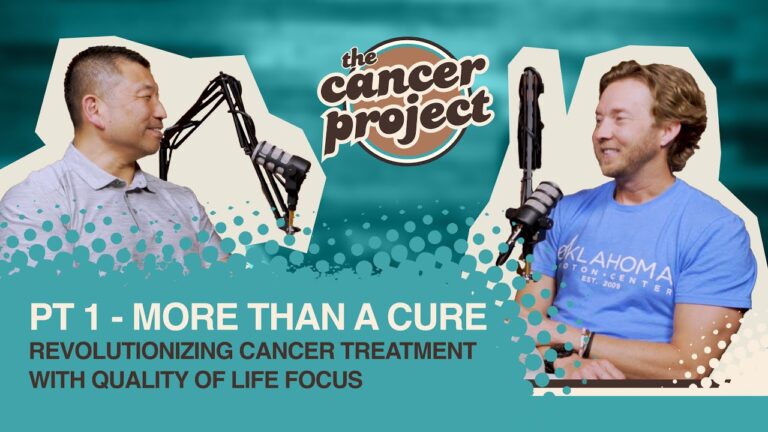
More Than a Cure Part 1: Revolutionizing Cancer Treatment with Quality of Life Focus
Join us at The Cancer Project
Get weekly stories, research updates, and ways to get involved.
This website does not provide medical advice. Content on The Cancer Project is for general information only and is not a substitute for professional diagnosis or treatment. Always talk with your doctor or care team about your health. Not all content is controlled by The Cancer Project or represents its views. Stories, research, and perspectives also come from patients, caregivers, podcast guests, and outside organizations.