Episode Summary
Giulia Rozzi has built a career as a comedian, writer, and storyteller by saying the uncomfortable thing out loud, and she brings that same honesty to her breast cancer experience. In this conversation with David Raubach, she opens with the lollipop she always earned as a model patient and explains why that rule-following instinct stopped serving her once she was facing a bilateral mastectomy, radiation, hormone therapy, and reconstruction.
Giulia describes a first oncologist who called her cancer the best case scenario, talked mostly to her husband, and left out information she needed. She learned the real picture only as she was about to go into surgery. She shares how that broken trust, the overload of medical jargon, and a stretch without her anti-depressant shaped some of her hardest months, and why she wishes a social worker had been part of her care from the first day.
She also talks openly about body image. After choosing to go flat, partly out of spite and chaos, Giulia realized that breasts mattered to her, and she eventually had a less common LAP flap reconstruction. Along the way she found that wanting to feel at home in your body does not make you vain or ungrateful, and that every choice deserves equal respect. She explains the meaning behind her Substack, Seven Bodies, and how comedy brought her back to herself.
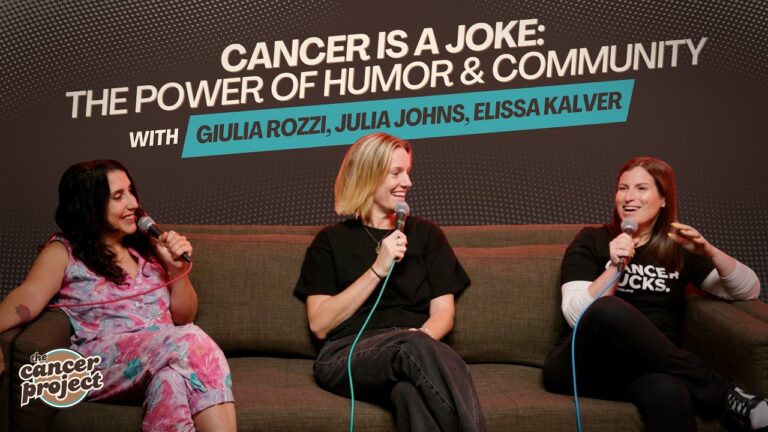
Giulia also speaks about her husband, the community that carried them, and her work co-producing the We Got This comedy fundraiser, Cancer Is a Joke. Her closing message to anyone newly diagnosed is simple: ask everything, ask for help, ask for more time, and ask for what you need.
What You’ll Learn in This Episode
- The model patient trap: Why being agreeable with doctors can leave you without the answers you need, and how Giulia learned to push for more information.
- Overwhelm and jargon: What it is like to make life-altering decisions while hearing medical terms that feel like a foreign language, and why plain explanations matter.
- Reconstruction options: How Giulia learned about alternative flap surgeries, aesthetic flat closure, and the choice not to reconstruct, mostly through her own research.
- Choice without judgment: Why going flat and choosing reconstruction are equally valid, and why caring about how you look is not ungrateful.
- Mental health support: Why Giulia wishes a social worker or similar guide had been there from diagnosis, and what she learned about care during a hard stretch.
- Online communities: The pros and cons of Reddit and Facebook groups, and the spaces that offered support without judgment.
- Humor as a way back: How comedy helped Giulia feel like herself again, and why a care team that can smile with you makes a difference.
- Support for partners: What Giulia’s husband meant to her, and why partners need more support too.
Giulia’s story is a candid, funny, and deeply human reminder that you are allowed to ask questions, take your time, and want what you want. We hope it leaves you feeling a little more informed and a lot less alone.
Full Transcript
Read Full Transcript
Transcript generated from the episode’s audio. Speaker names are identified from the context of the conversation rather than from recorded speaker data, and automatic transcription may misspell names and terminology. Please refer to the video for the authoritative version.
David Raubach: I want to thank you for joining us on today’s episode of the Cancer Project podcast. We are very privileged to have Giulia Rozzi with us. Today’s guest has made a career out of saying the uncomfortable thing out loud. Giulia is a comedian, writer, and storyteller whose credits include Conan, Comedy Central, Chelsea Lately, and writing for Southside, and Girl Code. Paste magazine describes her as an intelligent, perceptive mind that’s almost painfully aware of the foibles bound up in modern daily living. Over the last two years, she has brought that same candor to breast cancer, writing about a bilateral mastectomy, radiation, reconstruction, medical menopause, panic, depression, and the strange work of trying to recognize yourself again. And her Substack Seven Bodies is about, in her words, losing my boobs and finding myself. She sometimes flosses but tells her dentist she never misses a day and is such a model patient that she always gets a lollipop. Giulia, what a funny intro. Thank you for joining us.
Giulia Rozzi: I was like, how did you know the thing about, I was like, oh yeah, I wrote about the dentist.
David Raubach: Yes. In the Substack.
Giulia Rozzi: Yeah. Yeah. Yeah.
David Raubach: And it’s funny, cuz you just asked before we came on camera if you had anything in your teeth.
Giulia Rozzi: Oh yeah.
David Raubach: So that was a perfect segue to the flossing.
Giulia Rozzi: I didn’t realize I cared so much about my dental health. Yeah. I’m with you though. Like you’re stuck in a chair strapped down and the hygienist is like, “Have you been flossing?” And I’m like, I Yes. Yeah. Yeah.
David Raubach: No, absolutely. I can’t believe my teeth are bleeding. But the way I brush my teeth before a dentist appointment, it’s like the equivalent of, like I don’t know, like when I tidy at my house before like the house cleaner gets here, you know what I mean? It’s like no one’s fooling anyone.
Giulia Rozzi: Yes. Yeah. Yeah.
David Raubach: You can’t salvage 6 months of mediocre teeth or dental hygiene in 24 hours. Plus, you know, that’s what you’re paying them to do. So get you fixed up. Yeah. I do also, so we’re just going to go right in, I mentioned this in the intro. So the lollipop, because you talked about being a model patient.
Giulia Rozzi: Yes.
David Raubach: And what it means to be a model patient, but then maybe discovered that being a model patient all the time Yeah. doesn’t work quite as well as it does with your primary care physician as it does going through cancer. So just talk about like the model patient, what you’ve learned about being a patient.
Giulia Rozzi: Yeah. I mean, I think with doctors, you know, dentists, I’ve always been in like good health, right? And like I didn’t real It’s funny because I think some of my friends or people that know me would describe me, my parents certainly would be like, “You’re very rebellious. You’re like whatever.” But when it comes to like medical stuff, I I like I don’t know, know I’m such a rule follower in a way. I remember when I had a child and, um you know, the doctor would like ask you about like um any sort of postpartum, right? like you know Have you been crying a lot? It’s like, of course I have. But like I was like, oh no, but I’m like good, you know? I don’t know if that makes any sense, but there’s this I’m fine. Yeah, just give me an A on this medical test.
David Raubach: Right.
Giulia Rozzi: So I can go about my way. And so I think that kind of, I don’t know. It’s not like I’m minimizing symptoms, but I definitely when it comes to medical stuff have always been like I’m fine. I’m almost the opposite of a hypochondriac, right? Like I will be like bleeding and be like, we should take you to a hospital. I’m like, it’s just, give me like a Band-Aid. Like, I’m good. Because I have also had a lot of, I don’t want to say medical good luck, but like just, I don’t have, my parents are in their 80s, no health problems, knock on wood, you know, like I’ve not really had a lot of health problems. So when it came to cancer and I like failed the quiz, Yeah. you know, or whatever, it really threw me for a loop because I was like, but I did everything right. Like I eat well, I exercise, you know, genetic history is good, you know, and like how did this happen?
Giulia Rozzi: And so I think a lot of my cancer experience in the beginning was I was so overwhelmed, right, by all the information you’re receiving at once. Um, And the way, you know, unfortunately that certain doctors and medical professionals speak, it’s sort of like if you ever talk to like a financial adviser, they’re like, “Well, the Q10 and this,” and I’m like, I don’t speak this language. Tell me in like the stupidest terms ever, like tumor, booby, lose, booby, like I need a drawing, you know, like a chart.
Giulia Rozzi: And I feel like with that overload of information plus my “like oh okay, like sounds good” that I kind of get with medical professionals, I really learned after cancer, like I’ve absolutely changed. I used to be like worried about messaging them too much, especially with the reconstruction stuff. I feel like I did not ask all the questions I wish I had. Some of that is because again you’re overwhelmed, you’re anxious, you’re depressed. But if I were to like do cancer all over again, which like I don’t want to, I would really step back more and be like, I need more answers, more space, more time, more of everything to be better educated.
David Raubach: Yeah. We live in a very consumer-driven health care system in the United States, like more so than any place else in the world. Like we like our choices. Yeah. And you talked about with your reconstruction, you know, you you got offered, there was like some buffet options.
Giulia Rozzi: Yeah.
David Raubach: For what to do, and maybe they didn’t give you all the buffet options. So maybe specifically talk about that, because you’ve written about that in your Substack.
Giulia Rozzi: Yeah. I felt like when I got diagnosed and my GP, actually maybe I shouldn’t say who said this, maybe cut that, but um someone said to me about big cancer, or, okay, let me start again. Someone said to me about big hospitals, cuz I went to like a really good big hospital, fantastic care, you know, amazing surgeons whatever, but someone said to me, they’re like, you know, unfortunately sometimes these environments do have like a DMV quality to them because they’re just like, bing, you have cancer, next, and like send you off, you know?
Giulia Rozzi: And I felt like when it came to the reconstruction aspect of it, it was sort of like, they were like, “Okay, well, like you can get implants, you can get DIEP flap.” Um They didn’t mention not getting reconstruction. Um And they didn’t mention that there’s also like alternative flap surgeries that you can have. And when they started talking about the DIEP flap originally, I remember my surgeon just kind of like launched into medical terminology about the DIEP flap. She’s like, “It’s the gold standard of care.” And I was like, “I’ve never even heard of this procedure.”
Giulia Rozzi: So she was like, “So what are you thinking?” And I was like, what am I thinking is, my stomach could be my tits. This is insane.
David Raubach: Your love handles, as you described.
Giulia Rozzi: Well, I ended up having a LAP flap instead of a DIEP flap, which is one of those alternative flaps that I wasn’t presented to me in the beginning because my first hospital didn’t have any surgeons that offered that, which is fine, but it just felt like, you know, for me, first and foremost, I was like, am I going to live, right? Like That’s a very logical first question when you get diagnosed with cancer. But it was like in the middle of am I going to live? What’s my treatment plan? What are my reconstruction options? What’s my timeline? What’s insurance going to cover? It’s so many things at once. And I know doctors can’t control the speed of all that and the overwhelm. But I do feel like, I don’t know, there could be a better way Yeah. to present somebody with this. So like I I wasn’t, I mean, I was given like papers.
David Raubach: Yeah.
Giulia Rozzi: But they were in medical jargon, right? And I’m like, why isn’t there like a little cartoon book of like a little person like, these are your reconstruction options, like you know, I don’t know. It just felt really bizarre and unnatural and a little robotic. The whole experience felt like
David Raubach: Yeah. Like, Well, it kind of reminds me of like if a third grader walked into high school physics class and only went to one class.
Giulia Rozzi: Yes.
David Raubach: And then was supposed to go home and tell their mom about whatever, you know, like the speed of light and the calculation for gravity. Like You’d be like, well, no, that’s crazy. That couldn’t happen. But you’re walking into this world Yeah. of, you know, a lot of our uh medical terms are Latin. It’s not even English, like, you know, and they have a history that traces back hundreds or thousands of years. Yeah. And then you’re supposed to just, like you said, process all that and make really, really life-altering decisions.
Giulia Rozzi: Yeah. And I also, especially with the plastic surgery of it all, I was like terrified to upset anyone who was going to be doing plastic surgery on me with my annoying questions, because it’s like when a waiter spits in your food or a chef spits in your food, you know what I mean? It’s like, if I upset my plastic surgeon, are they going to like put a nipple on my shoulder, or like one of your breasts will be slightly smaller than the other one? Obviously, they’re not. And and God bless them all for doing the work that they do, but I don’t know. I’m such a personality, humor driven person. And I know like I needed a team around me that had a sense of humor. Yeah. Because that’s how I cope with things. And some of my team didn’t really have a sense of humor, which I understand. They’re doctors. They’re not comedians, right? But when I’m like making a joke like that and they’re like, “Yes.” Anyways, and it’s like like, I can’t
David Raubach: It does sound like the DMV. They don’t have the DMV either.
Giulia Rozzi: Yeah. And then I also, you know, I don’t know how much of the Substack you read, but like I unfort I had an experience where my first oncologist really misinformed me and left out so much information.
Giulia Rozzi: Um, and basically led me to believe that I had the easiest cancer. Yeah. He kept calling it the best case scenario and that this was going to be basically easy breezy. He also mostly talked to my husband.
David Raubach: Oh, yeah.
Giulia Rozzi: And when it was happening, I kind of said something to my husband and he agreed, but we both were like in such a trauma state that we’re like, “No, maybe we’re just like being, there’s a lot of that.” I think when you’re first diagnosed, you’re like, “Oh, I’m just being paranoid. He knows what he’s talking about.” And it’s like, no, he was absolutely minimizing what was happening because he didn’t want to deal with like a hysterical woman, I think.
David Raubach: Well, so, and let’s talk about that specifically. So he said that you were just going to have to have surgery, or probably just going to have to have surgery.
Giulia Rozzi: Yes.
David Raubach: And but then it ended up after the fact that that was not the case. So maybe correct, tell the story.
Giulia Rozzi: Yes. Okay. So, you know, it is a weird thing cuz my experience was, like I get diagnosed and then they’re like, pretty much, like go on the website and just pick doctors. So, I was like, you know, this person looks nice. Then, you know, I got a recommendation for this. Like, I didn’t know what I was picking here. You know, I wish I could have done some speed dating or, you know, and um and so I I picked this guy based on a recommendation and he, well, he was the only person on the team that did have a bit more of a sense of humor. Okay. So, I was lured in at first cuz I was like, “Okay, great.”
Giulia Rozzi: Hey, like my other two doctors are a little bit more serious and he’s the comedic relief. This is a nice balance. So, we go to the office and I literally, first question, I was like, “Am I going to die?” He’s like, “You’re not. Please, you’re not going to die.” Yeah. But I could, you know, like, right? Um, So you’re not going to die. And then I was like, “Okay, do I need chemo?” And his response, it was as if I had walked into a Chinese restaurant and was like, “Can you iron my pants?” You know what I mean? He was like flabbergasted that I was asking about chemo to my oncologist.
Giulia Rozzi: He was like, chemo, okay, you’re getting ahead of yourself, is what he said to me. And I was like, “Okay.” Because you know, you think cancer, you think bald, chemo.
David Raubach: Probably one of the first questions that comes to mind.
Giulia Rozzi: Yeah. Yeah. I don’t know anything about cancer. Thank God at the time. Thank God I didn’t know. I didn’t have to know. So he like poo-pooed that. He goes, “I don’t even think about that right now. It is your cancer. You have such an excellent prognosis.” Excellent prognosis. That’s what he kept saying. Excellent prognosis. And I was like, “Okay.” A lot of hyperbole, a lot of, you know, best, excellent. Yeah. Excellent to me is no diagnosis, you know. Excellent to me is you have been diagnosed as having a million dollars, you know, like that’s a great diagnosis. So, don’t even think about the, okay.
Giulia Rozzi: And then I go, okay, radiation. He goes, I mean, one step at a time. He kind of just like kept avoiding it. And then I was like, okay, well, I have hormone positive breast cancer. I most certainly am going to need, uh I know there’s a better term for it, but it’s like the hormone reducing blockers, I’m really bad at medical terms if you haven’t noticed. I really hate them. Um The pills that make you not have a period and feel old. Uh And walk like your dad who’s 80 something. Um But and he goes, I mean, maybe not. And I was like, really?
Giulia Rozzi: And he was like, yeah. Uh And then he started talking about a patient that he had who had um testicular cancer and how he was an architect and after he went on basically the same thing.
David Raubach: Basically the same thing.
Giulia Rozzi: And after he went on that medication, he couldn’t draw anymore and he knows I’m an artist and he doesn’t want to do that to me. So I was like, “Wait, what? I didn’t read this anywhere on Reddit about losing my creativity.” So he’s like, I’m really conservative, so I want you to do the least amount of stuff that you have to if you don’t have to. I’m like, okay. And so I left there. And for me personally, I was hopeful to not, I didn’t really want implants, but the DIEP flap at the time, because I was not super informed about it, sounded like an outrageously invasive surgery, which it is. It’s very invasive. And I was like, well, this doctor just told me it’s like, wham, bam, thank you, ma’am, cancer. So, I was under the impression, super no biggie, double mastectomy. 3 months later, I get my permanent implants. Boom. The timing was great. My birthday would be three months later, I’m going to have a big look at my new tits party. You know, like I was already sort of a gender reveal.
David Raubach: It’s a birthday reveal.
Giulia Rozzi: Exactly. like I was already planning the outfit. I mean, because I think what happens, I can’t speak for everyone, but for me it was like I hadn’t even experienced the grief, I hadn’t even experienced any of it. I was just already ready to be like, okay, how do we like get this over with as soon as possible, and I’m being told that like I’m so lucky. I felt like he made me feel so lucky that um a few nights later I went out to dinner with two women who had had breast cancer, double mastectomies, you know, some radiation, uh chemotherapy, all this stuff. And I went out to dinner with them and they were telling me how horrible their experience was. And because I had just been told that it was like no big, I ended up, out of guilt, paying for dinner.
David Raubach: Oh, my gosh.
Giulia Rozzi: They didn’t ask me to, but I was like, my cancer is not as bad as your cancer. I have the good cancer. Meanwhile, I felt like a, you know, a fraud almost. So then I So I I decided to go with the implants cuz this doctor made it sound so easy. And then I’m literally, cap on, you know, about to get the IV, the IV is being put in me and my breast surgeon comes in. She’s like, “How are you feeling?” You know, like ready to go into surgery, and I go, “Yeah, honestly, like I feel really good.” And my husband was with me through all of this cuz you know when you have an experience and you’re like, “Am I making this up?”
Giulia Rozzi: Right. Right. But then my husband was with me and I was like, “Yeah, I actually, Dr. blah blah blah like kind of told me this is like all I have to do, like I don’t need,” and I like told her everything and her face just like dropped. She goes, “What are you talking about?” And I go, “That’s what, right?” And my husband’s like, “Yeah, that’s what he said.” And she goes, “I’m so sorry, but none of that is true. Like you I’ve never met anyone with your diagnosis for whom the medication wasn’t recommended. We don’t know if you need radiation until we know if it’s in you know, your lymph nodes.
Giulia Rozzi: And we definitely don’t know if you need chemo until we’re in there.” So, yeah.
David Raubach: Oh my gosh.
Giulia Rozzi: And then she walked off to do whatever. I was like, “Give me my phone.” Then I went back into the chart because I remember I had messaged him, and what I did, and I don’t know that this is the best method, but after every like meeting I would have, I would always message the doctor back and be like, wait, did I get this right? Yeah. And he was like, yep. And so when she came back and I go, “Yeah, I have a message if you want to see it.” And she goes, “No, it’s okay. Let’s just get you into,” so I went into surgery. I had done like weeks of like this meditation that’s supposed to prep you for surgery. I was zen and then I like went into surgery being like, “Oh, I don’t trust any doctors.”
David Raubach: Oh my gosh.
Giulia Rozzi: Everyone’s a liar.
David Raubach: So as you’re getting put to sleep.
Giulia Rozzi: Yeah. So then I wake up with my um temporary, you know, spacers in and you know I’m you know on all the drugs so none of this is really hitting me yet. And then you know it’s like a week after, I think, when you get like the pathology back. Yeah. And I’m in the office with the surgeon and she’s like, okay, so um it’s in your lymph nodes. Um So we need you to do a scan to see if it’s spread everywhere else. Our number one recommendation would be radiation because it’s spread, right? um I had lobular and there’s a lot of research that chemotherapy tends to not be recommended if your ANC score is under 20, because there’s something about lobular and chemotherapy where there’s a lot of mixed sort of results with it.
Giulia Rozzi: So they’re like, “So we have to do your ANC score. So once we find that out, we’ll know if you need chemotherapy, and if you decide to keep your implants, you know, you’re going to have to keep them in for a year because after radiation, the skin needs to heal.” And then my plastic surgeon’s like, “I don’t know if I would recommend implants after radiation because these are the skin things that can happen.” And I was like, “What?” And I like like everything changed. Everything changed. And I And so then the oncologist called me and was like, “Hey, so,” you know, like reiterated the results and he’s like, “you know, we’re going to do, we’re going to,”
Giulia Rozzi: and then at the end of it he goes, “Do you have any questions?” And I’ve never spoken to a doctor like this. This is when being a good patient went out the window. And he goes, “Do you have any questions?” I go, “Yeah, I have a question. Why the f*** didn’t you tell me any of this in the beginning?” Yeah. And he goes, “Okay, well, like I didn’t want to overwhelm you.” And I go, “Well, I’m f***ed up.” Like My husband like came downstairs cuz he heard me. I’m like, “Well, I’m f***ing overwhelmed now.” And he was like, “Okay, you know, I understand.”
Giulia Rozzi: I’m like, “You don’t understand, how can you? You’re
Giulia Rozzi: a liar.” Right. Right. You assumed that I couldn’t handle it. I would rather a doctor say to me, “Here’s the deal. You might have to do nothing. You might also” What if I got my scan results back and they were like, “It actually has spread everywhere and you’re going to die.” That was a possibility. And it made me feel like, how dare you. And I’m really not somebody that blames, like, oh, it’s a man and he’s dealing with breast cancer and he talked to my husband. Like I really don’t pull that card very often. But this was a scenario where I was like, this f*** Can I swear?
David Raubach: Yeah.
Giulia Rozzi: Okay. Yeah. I survived cancer. Can I swear?
David Raubach: I was going to say I like that you asked after like five f-bombs.
Giulia Rozzi: Oh, by the way, I don’t know what your audience is like, but I was like, well, we’re going to be picking up a new audience now with this interview. The audience that loves ladies that talk about d*** and, uh, no, but I I was like like, how dare this guy, he was the only guy on my team too, control my emotional response to my breast cancer. So then the second thing that happened in the midst of this, and I do feel like it’s important for anyone listening to this to know, is I had always, I not always, but I had been on an anti-anxiety anti-depressant for many years before cancer and then had been uh experimenting with microdosing psilocybin and so I had gone off my medication, microdosing was going great, and then you know when you are prepping for surgery they have to ask you to quit doing things that could interfere with anesthesia.
Giulia Rozzi: So, I quit the microdosing. And in the mayhem of surgery and now the scan and this and that, I didn’t even think to go back on my anti-depressant. So, I just was on nothing during all of this. And that also didn’t add to my responses of, it was
David Raubach: And then, you know, as you affectionately called it, you were trying to raw dog cancer.
Giulia Rozzi: Raw dogging cancer, and I don’t, and you don’t recommend that. I don’t recommend it. I’m not saying you have to be on medication, but I do think I was given, um, toward, well, I guess I should probably go in order, but later on in my experience at my hospital, which again, wonderful hospital, like this isn’t a jab at the hospital. It’s just the system. like It wasn’t until I was extremely depressed, very, very depressed after a few other things happened that we can talk about, that they were like, “Oh, do you want to talk to one of the social workers?” And I was like, “What? There’s a social worker?” Because I was trying to talk to my regular therapist who’s like, “Let’s talk about your childhood.”
Giulia Rozzi: I’m like, “No, I don’t. What is this about my childhood? Where are my nipples?” You know, and so I was like, why wasn’t the social worker there? Not even when I got the diagnosis or when I had to come in and get like the second round of bad news, like because my social worker therapist that they provided ended up being phenomenal and then really helped me through when I later decided to do like a different reconstruction path and all that stuff. And I’m like, everyone who goes through this should have some kind of, like, I don’t know, doula, shaman, whatever you want to call it, who can, like after you leave the meeting, and be like, okay, this is what they mean.
Giulia Rozzi: Yeah. And like, you know, let’s process this. It was like, oh, she yelled at the doctor, get the social worker. It wasn’t even yelling at the doctor.
Giulia Rozzi: What happened for me was that, so, you know, thank God my scan came back. It hadn’t spread. Um, My ANC score was below 20, so they didn’t recommend the chemotherapy. I did have to have radiation and I did have to go on the medication and that was fine. And then I still didn’t go back on an anti-depressant because, you know, they thought they were going to put me on one, it was most likely going to be an anastrozole, but you know, they were like, well, but, and I’d already switched oncologists at this point and loved my new oncologist and she was horrified by my story and God bless her. Um, And she’s been a wonderful advocate, but she was like, “But if the anastrozole gives you too many bad side effects,”
Giulia Rozzi: which according to Reddit was going to, and luckily it hasn’t been that bad, but um then they would maybe switch me to, I forget what the other one, tamoxifen. And tamoxifen, I think you shouldn’t take it with Zoloft. So then I was having my psychiatrist, I was like, well let me preemptively try a different one, so then I was like trying new medications while I was already feeling crazy, it was just very messy. Yeah. Eventually I ended up going back on Zoloft and the anastrozole chilling back to me, like everything worked out in the end. But I I got introduced to the social worker because, um you know, my plastic surgeon tells me that she’s like, you can get implants after having radiation.
Giulia Rozzi: Plenty of people do, but here are the things that could happen. Yeah. And I had a really hard time with the temporary implants. I was just hyper aware of them in my body. Maybe that feeling would have gone away after getting used to them, but again possibly my unmedicated brain was like, I need these out. I I hated them. And I was so mad at that doctor. And when I talked to that doctor and I was like, hey, I don’t know if I’m going to, he’s like, “So, what’s your plan with um your reconstruction?” this guy, and I was like, you know, I think I’m actually gonna remove the spacers and I think I might just do aesthetic flat closure because this is chaos and I’m like mad.
Giulia Rozzi: Yeah. Um And I also had lost a lot of weight from stress. So I didn’t even have at the time enough body fat to do a flap, right? And And I hadn’t made my decision yet. I was just like exploring it. And he goes, “Do you think you can handle that?” Here’s the thing. It turned out I couldn’t. Okay. But because he, as the man, Yeah. that really ruined cancer for me. Right. Right. I’m like more mad at him than at the genetic mutation because I didn’t trust him. I almost was like, I’ll f***ing prove to you that I can handle being flat. Like Now it became like, well if he thinks I might not be able to handle it, he’s a pig and I’ll show him.
Giulia Rozzi: Which is like a horrible, but you know when you’re in the middle of cancer you’re looking for something to feel empowered by.
Giulia Rozzi: So then going flat for me, again I support anyone’s choices.
David Raubach: Choices being the big word. Your choice, not everyone else’s choice.
Giulia Rozzi: Choice. I then made this choice like almost out of spite and chaos. And the truth was I actually I could have gotten those temporary implants removed and not done anything, right? I could have, you know what I mean? Like I didn’t have to do an aesthetic flat closure, which is a very big choice, you know? Um, And so I did that and I was okay for like a week after that surgery. I had the aesthetic flat closure done five weeks after my double mastectomy. Back with the drains, back with all the s***. And then for like a week I was like, “Yeah, this is going to be my new thing. I’m a flat advocate.” Like I was like, “I’m going to start a nonprofit.” You know, again, get her some meds.
Giulia Rozzi: But I was like, done. And then that’s when I started losing it because I was like, “Oh, I actually don’t, this wasn’t the choice for me.” Yeah. It was a choice informed by like chaos. Like That’s the only word I can keep thinking of. So then that’s when they introduced me to the social worker because I was going through a lot of gender dysphoria. Yeah, I was um losing sleep because I was like, how could I have been so stupid to think that, I like I thought I had made a feminist choice, right? Realizing that like breast cancer, cancer is not the time to, we’re not looking to be noble, right? That’s not the advocacy, it’s self-advocacy for like what do I want, what do I need, right? How can I find the team and the people to support me with that?
Giulia Rozzi: It’s not like I’m better than you because I don’t need reconstruction. That’s actually not even feminism. Feminism is everyone has a choice, right?
David Raubach: So that’s, and each choice has equal merit.
Giulia Rozzi: Exactly. But I didn’t have, I was making huge life choices with very little information, and what I viewed as a dishonest, I didn’t trust doctors, right? Because and all the rest of my doctors were great, but because this one guy f***ed me.
David Raubach: Yep.
Giulia Rozzi: Not literally.
David Raubach: Uh Thank you for clarifying. Yeah. Yeah, that’s good. We cleared that in. Keep that in. Yeah. Yeah. Just write that down.
Giulia Rozzi: Yeah. So, you know, cut to a few months later after um some really bad months mentally. You know, I started my hormone treatment. I got back on my Zoloft. Much higher dose.
David Raubach: And much higher dose. No more raw dogging.
Giulia Rozzi: No raw dogging. And I had a wonderful friend say, and I was also like obsessively looking up if I could still do reconstruction because I needed to know that, I had a lot of regret, me personally, and um my very good friend was like, listen, nobody’s going to operate on you when you’re this insane, so can you like stop focusing on re, like can you focus on getting healthy as a human and then anything’s possible. And my radiologist actually said the same thing, because when I rang the bell, I was sobbing. And my radiologist is like, “Are you like excited that you finished radiation?” And I go, “No, I’m crying cuz I wish I was dead cuz I missed my boobs.”
Giulia Rozzi: And she was like, “Uh, okay.” We’ve never had this happen before. And she also was like, “Surgeons are miracle workers. We’ll get you your breast.” And I’m like, you promise? Like I was my breasts. And you know what I really learned is I was like, breasts are important to me. I was like, f*** the male gays and all this stuff. It’s not even about the male. It’s about the Giulia gaze in the mirror. And that’s what I wanted. So I ended up like recouping, getting healthy, getting to a place where I didn’t need breasts, but I wanted them, and doing the work. And then I gained my weight back.
Giulia Rozzi: You know, wasn’t that hard. Um and uh And you know, found a surgery, but not mac and cheese.
David Raubach: Not mac and
Giulia Rozzi: Yeah, cuz I hate mac and cheese.
David Raubach: Well, you really did a lot of research. Yeah, I read your Substack and then that was, I mean, to be fair, you did put an Instagram post out that said, “Let me introduce myself.”
Giulia Rozzi: I did. I felt like I should start there.
David Raubach: Yeah, I did. I did that. And then it said, you know, at the end it was like, “I don’t like mac and cheese.” And I was like, “Oh my gosh, do I have to interview this person?”
Giulia Rozzi: Yeah. Yeah. I really am, my to bring it up. Um, No, but I well, yeah. So, I’ve, you know, then I started working with a different surgeon also because there was a bit of the like I
Giulia Rozzi: didn’t want to go back to the scene of the crime. My first surgeon was amazing, but you know, I had already had two surgeries with her and I just wanted to see
David Raubach: Yeah.
Giulia Rozzi: I took my, I had time now and so I ended up having a LAP flap, love handles on my
David Raubach: Right. Right. And now you have this, and what was the side effect that you talked about, the booty lift? So okay, can’t get enough booty pictures.
Giulia Rozzi: I can’t get, I okay. So the great thing about the LAP flap, ladies, guys, I don’t know, um is you when they take from your love handles, they have to like pull up your skin to sew you back up, gnarly scars, but it ends up being a butt lift. So, I’ve literally had people be like, “What have you been doing for your butt?” And I was like, “Cancer.”
David Raubach: Cancer. Yeah. Actually, cancer. Just get cancer. This is the one thing I wanted to work into this interview was the booty lift side effect. I’ve never heard that before.
Giulia Rozzi: It’s well because it’s also um not a lot of surgeons perform it. The reason, what I found out, is it’s a rare surgery. It’s a rare surgery because the reason why um a lot of plastic surgeons use the abdominal fat is because the blood vessels are long and so they can reattach them a lot easier. When you have an alternative flap, what I mean by alternative is there’s like inner thigh. Um There’s SGAP, which I think SGAP is right above the butt, or that might be right underneath the butt. There’s like a lot of different areas where they could take from. Um uh A lot of those blood vessels tend to be, I know for the LAP flap the love handle blood vessels are shorter.
Giulia Rozzi: So part of the surgery is a lot longer because they have to like make an extension cord for the blood vessels. Also, you have to flip a patient over during the surgery, which you know is not ideal. So there’s a lot fewer surgeons and it’s just, you know, another specialty to have. So, it was really funny because actually recently when I had like a follow-up, my plastic surgeon, uh, she was like, I was like, you know, I didn’t realize like not a lot of surgeons do this. She goes, oh yeah. She’s like, you know, I was like, thank you for the surgery. And she was like, well, thank you. Like, I mean, you’re only my like 40th patient that I’ve done this on.
Giulia Rozzi: And I was like, wait, what? Like, She did a phenomenal job, but I was like, I’m kind of glad I learned that after.
David Raubach: That was the one thing you’re glad you learned after the surgery.
Giulia Rozzi: Yeah. Yeah. Yeah. But I mean the whole experience, just like I actually learned, I don’t know, I think it’s very easy, and I don’t want to speak for all women obviously or humans really, but like I think there’s a lot of mixed messages out there, at least for me, of like whether it’s good or bad to care about your appearance, right? And in the midst of breast cancer I felt like there was so much, like you should be so happy that you’re living. You should be so happy that you’re going to survive. The body part of it, how your body looks, just be glad you survived. And I know people were well-meaning in that and I don’t think a lot of people meant to speak like that. So, I really started speaking like that to myself where I was like, “You’re an a**hole for wanting breasts. How dare you when there’s people that die of cancer?” And it’s like, you can want whatever you want and honestly everyone should have what they want and have access to what they want.
David Raubach: Right. Right. Yeah. So talk about, you mentioned Reddit a couple times. Talk about the pros and cons of managing your medical care through the Reddits.
Giulia Rozzi: Reddits and also a lot of Facebook groups.
David Raubach: Facebook groups. Google, Google Doctor.
Giulia Rozzi: Google, you know, Google’s tricky because I mean Google can be okay because you can find actual, you know, reputable sites, but you can also land on some places you don’t want to. I found Reddit to be fairly neutral. Okay. Sort of in the cancer space, people tend. I will say there was, in the midst of my whatever, like there was one time I posted on Reddit and like a plastic surgeon responded to my question and was like, actually getting implants with radiation is totally fine. We do it all the time, and here’s the thing, none of these
David Raubach: In that tone too, probably. Yeah, exactly.
Giulia Rozzi: None of these things are totally fine. Like I said, yeah, that’s true. Some people get implants, have radiation, and they are totally fine. But it is not like some people get a flap surgery and they’re not fine. You know what I mean? Everyone should know the risks and rewards to all of these things. So you have to take it all with a grain of salt. The message boards were actually quite interesting because um you have to remember that a lot of people post online when they’re upset. And so you don’t always get the positive stories. My surgery was a success. I actually wasn’t in a lot of pain. Recovery wasn’t that bad. My medication symptoms weren’t too horrible. It’s usually people being like, “This is a nightmare.” You know, and so overall I I think it’s illogical and unrealistic to say to somebody, don’t research, right?
Giulia Rozzi: Because if it wasn’t for my research, I would have never known about aesthetic flat closure. I wouldn’t have known about alternative flaps. Those weren’t things that I was taught by my team. But I also did unfortunately have a couple experiences, like there was a flat message board that I was on when I was trying to make that choice and there were some people who did reiterate what I was already saying to my head of, like if you want reconstruction you’re bad, right? Right. You know, and and that’s not helpful either, you know, and so the spaces where I found the most solace was spaces where people were like, “Hey, any questions you have, we’re here for you. Whatever you choose, you’re part of the community.” Like, Everyone’s just doing their best.
Giulia Rozzi: And just because I choose one path, I’m not choosing it and saying you’re wrong for yours, but it’s like what is right for me?
David Raubach: Non-judgmental, very pragmatic. Yeah. No, I like that. I like that. So, your Substack, uh the title is Seven Bodies. I think I’ve counted all seven bodies that you’ve described through these different stories. So, talk about why you named the Substack that and what were you thinking when you said this is Seven Bodies, that’s what I’m going to talk about.
Giulia Rozzi: Um I don’t know why I picked seven. Maybe because it had a nice tone, but I I was thinking it was like my precancer body, my um uh temporary implant body, my flat body, my super skinny flat body cuz I lost a lot of weight, then my flat body with gaining weight, then reconstructed body, and then menopause reconstructed body. So those were kind of the seven. And then what’s really interesting is I totally didn’t even think about the fact that there’s like seven bodies is also, I didn’t think of this at all when I came up with the name, but in yoga, and uh you know, like there’s seven celestial bodies and um I think there’s seven chakras. I don’t know. Anyways, there’s something, we’ll have our producer, I have your producer look it up. Um But uh get on it. Um But somebody open Reddit.
David Raubach: Yeah, go to Reddit.
Giulia Rozzi: Um They’re going to be like, cuz on Reddit they’ll be like, “Oh, no, it’s five chakras.” No, it’s eight chakras. Eight chakras. Well, I only have seven, but um no, I but there is a spirit, I didn’t realize this, there’s a spiritual element to seven bodies and I was like, well, that’s cool. Like That kind of fits the mix, too. So, yeah.
David Raubach: Well, and the seven days of creation too in the Bible too. That’s a very, like, seven is the number of completion as well. So yeah, look at that. Look at that. Um Why did you start writing your Substack?
Giulia Rozzi: Oh, great. Well, you know, you got to be on the internet. Okay. You got to, content, content, content. Exactly. Yeah. Uh No, I
David Raubach: That’s a good plug for the internet. Yeah, that’s a good plug for the internet. You got product placement there.
Giulia Rozzi: Yeah. Um, So, I started it, uh, you know, I’m a writer. I had started a Substack before that was kind of like had no direction. It was just me kind of blabbing and then I hadn’t, there’s not a lot I I haven’t found a lot out there that talks about the mental health aspect of breast reconstruction. Um, And I’m funny and I feel like comedy is, you know, a way to get into some of the deeper things that I want to talk about and and issues that are there. And so, you know, I I started it for that reason.
Giulia Rozzi: It’s also a place, I because I also have not figured out yet what I want to do. I know I’m telling my story to you and I’m, you know, writing about it on Substack, but like I also know that there’s more that I want to do with it and I don’t know if that’s, like, you know, a keynote talk or a solo show or, and so the Substack has in a way almost been like an incubator to kind of see like which stories people are really resonating with and what they’re interested in.
Giulia Rozzi: And yeah, I’m kind of trying to, it’s a good place right now for me to figure out what to do with all these thoughts and feelings and information and experiences I have.
David Raubach: Has comedy for you been a way to escape what you’re going through? Deal with what you’re going through.
Giulia Rozzi: Okay. For sure. And and when I was in the real dark place, I mean, I didn’t really even make jokes. And so it was really nice because when I started making jokes about it, it’s kind of when I think everyone around me could take a sigh of relief and be like, “Oh, she’s herself.” Yeah, she’s herself again. Because I really, I do find everything funny and what’s been so nice about working with, um you know, I do a lot with We Got This, I hope I’m not jumping the gun, but you know, I’m co-producing Cancer Is a Joke for We Got This. And it’s just so nice to be around people where I can make like the really f***ed up jokes. Right. It’s funny because sometimes someone will try to make a f***ed up joke to me and I’m like, you don’t get to say that actually, you know, but like these gals and guys who have been through it. Yeah. We can talk about it all the time.
David Raubach: So you mentioned, I I’m curious about this. So because you mentioned that you picked your first physician because you thought maybe he had a sense of humor.
Giulia Rozzi: Yeah. Yeah. And it turned out he was a narcissist. Yeah. And so that’s what it is. You’re a narcissist.
David Raubach: Uh, so do you still think that, like having gone through that, Like is that still important? Like Do
David Raubach: you want your clinical team to kind of be like in on the joke or laugh at the joke or you like, eh?
Giulia Rozzi: Yeah. Well, I realized he wasn’t actually funny cuz he kind of laughed, he was just more animated is maybe probably a better word. Part of why I fell in love with my current plastic surgeon is she’s funny, but what this really did happen is my husband and I were there for a consultation. She was, you know, sort of going through the medical stuff. She was really good at like also explaining it in, you know, people language and not robotic language, right? And then I made a joke to my husband. My husband is also a comedian. And then he made a joke and she was like on her computer and then she goes, “Wait a second.” And then she did like a call back to our joke and I was like, “Oh, you’re funny, but you’re not trying to like put on a show for us. You’re just, like I don’t know.” Her vibe was just like she was in on the joke but not super
David Raubach: chill. Yeah. Exactly.
Giulia Rozzi: So, do I still look for that? It’s not so much that they have to be funny. I just need them to like smile when I’m making fun of what’s happening. Right. Right. Right. Right. And not be like, “Okay, we’ll be right back with you.” Um, okay. Uh, I don’t, oh, that was so weird. You know, like that I can’t
David Raubach: Yeah. Yeah. What? So, some of the funniest people that I’ve found in cancer centers are actually the radiation therapists because you kind of like you get to see them every day and you’re kind of invulnerable and you’re not under anesthesia and so like you have all this opportunity to kind of get to know them. So did you have that rapport with your radiation therapy team doing radiation?
Giulia Rozzi: They were, well first of all my radiology doctor, I loved her, the one who was like, are you crying out of joy, and I was like, no. She always had, like I don’t know, like fun earrings on and like was just like so, like you know, would like put her hand on my hand and be like, baby, it’s going to be okay. She had a little bit of a twang. She’s like, baby, it’s going to be okay. Like It wasn’t even so much a sense of humor. It was just like a lightness about her and not a toxic positivity, like a realistic positivity. And then Yeah. Like the radiology technicians, like, you know, they would be like, “What do you want to listen to?” Like music. And I’d be like, you know, “Let’s do EDM today.” Yeah. And they were just, I, it wasn’t funny. They just were like real people. Because you know in medicine, like I said, sometimes there’s sort of like a, I need to be professional, and I understand that cuz you know I’m sure there are people who complain where they’re like, why is my doctor smiling?
David Raubach: Yeah. My doctor’s not wearing a tie.
Giulia Rozzi: Yeah. Exactly. It must not be serious. Yeah. And I’m like, take off your coat, like you should lay down, you know.
David Raubach: Yeah. Yeah. Yeah. That’s fun. So, uh, how have you started to incorporate, I I know you’re doing Cancer Is a Joke, but just kind of in your other, like not directly with that. Are you incorporating cancer into standup more now or are you still trying to kind of figure out how to navigate that?
Giulia Rozzi: I’m trying. And I’ll be honest with you, I I don’t do as much standup as I used to because I discovered during cancer that, like uh you know, it’s a nightlife lifestyle. Standup is not very glamorous.
David Raubach: Well, it’s physically taxing, too.
Giulia Rozzi: It is. And I’ve tried, but I also have learned that, like, you know, if I’m at like a comedy club and people have paid $30 for tickets plus two drinks and then I’m up there being like, you know, when they removed my, you know, like, and it’s funny because when I’ve tried it at places like that, I always have someone come up to me after the show and be like, when you said, “Has anyone here had breast cancer?” I wanted to raise my hand, but I didn’t want to like ruin the vibe. And I’m like, “Oh, yeah.” Like Comedy is also service work in certain environments. And so if I’m being paid to be somewhere and make people laugh, it’s tricky sometimes to be like, well, I want to make them laugh, but I also want to like get the story out. And so very long answer to your question, yes, but that’s why I’m toying with the idea of like a solo show where people know like this is what it’s going to be.
David Raubach: Yes.
Giulia Rozzi: And and again, like I don’t even, for me the cancer of it all, I feel like there are people who’ve like got that locked, like they are doing the content and the comedy about it. Yeah. I honestly, I know everything that happened to me was because of cancer but the cancer of it all, that I don’t know why. I think it’s because I’m not, like I said, like I wasn’t never a hypochondriac. I’m like, ah, give me a Band-Aid, I’m fine. like With the cancer of it all, I’m like, “Yeah, yeah, give me the medication. We’ll be good.” It was the overnight dramatic body, Mrs. Potato Head, what are you doing to me?
Giulia Rozzi: And every time I got a new surgery, cuz I ended up having four, it was like another like cutting into my body, rearranging, and it was treated at times like no biggie, right? And that’s like, oh, this is just part of the process. Yeah. And it’s like, but you know, I I was talking to a trans friend of mine and I was like, and we’re going to talk more because I feel like I understand him more now. Not the same thing, but there were moments again for me where without breasts on my body, I was really struggling with my gender identity and it didn’t make logical sense to me.
Giulia Rozzi: And I’m like, nobody told me that I might feel that way. So like that’s the stuff I’m trying to get into and, yeah, we’ll see where it lands.
David Raubach: So we’ve plugged Reddit. We’ve plugged the internet. I want to plug Will now. I think this is a good segue because you you’ve talked about these like physical challenges that you’re going through. Yeah. And when you’re married going through that, it just adds a whole another layer mentally to like just navigating that. And you’ve talked about just how supportive and awesome he’s been.
Giulia Rozzi: You’re going to make me cry through this process.
David Raubach: And so like just just talk about what he’s meant to you going through the last few years.
Giulia Rozzi: So, what was crazy too, not to bring the mood down, but the year before I got diagnosed, my husband lost his dad to cancer and his best friend to like a freak bicycle accident. And then before he really had a chance to like grieve any of that, I was like, “Oop, I have breast cancer.” So, all I can say is I would be shocked if we ever weren’t together because if we didn’t get divorced after that trifecta. It was really hard on him.
Giulia Rozzi: Um But yeah, I don’t know. We just, he’s an extremely supportive person. He did what he could. We both really learned in that process to ask for help. Our community of family and friends, I am never allowed to question if I’m loved or liked, you know, like that. Like It’s funny. Before cancer, like I’d be like, I’m mad. Why was I invited to that party? It’s like this s*** you worry about. And now I’m like, I am like the luckiest person on earth for my support system.
Giulia Rozzi: But my husband was incredible. And I And I wish, and I think that there should also be way more support for partners. Way more support because, you know, he knew less than I did, right?
David Raubach: You know, just the very fact I think of him going to appointments with you is probably super meaningful. Like Just having him there by your side.
Giulia Rozzi: Oh, yeah. Yeah. Yeah.
David Raubach: What? So, just to, so, last question. This is your opportunity to talk into the camera. Okay. I know this is what you’re good at. This is your specialty. Uh You’re going to look into the camera and this is a message for somebody who’s just been diagnosed with cancer. You’re giving them a word of encouragement, word of advice, whatever it is. What are you saying to that person?
Giulia Rozzi: Um, this camera.
David Raubach: Yes.
Giulia Rozzi: Uh, Ask everything. Ask for help. Ask for what you need. Uh, Ask your doctors all the questions you want. Ask for more time. Ask if you need to make these decisions so urgently. Ask, “Can I take a minute?” Ask, “Can I get a follow-up? Can I get a second opinion? Can I talk to someone? Can I take a breath? Can I speak to a social worker? Can I have some supports?” Like, ask, ask, ask, ask. And anyone who is uncomfortable with your asking, f*** them.
David Raubach: I love it. One last f-bomb.
Giulia Rozzi: Yeah. To close it out.
David Raubach: That’s perfect.
Giulia Rozzi: F*** had to. No, I’m just kidding.
David Raubach: Well, there you go. So, uh, that was amazing. Thank you so much, Giulia. I would love to do this again. I only got through five of my 78 questions, so let’s do a follow-up. Thank you.
Giulia Rozzi: Thanks.
David Raubach: The Cancer Project podcast is made possible by the Oklahoma Proton Center, a state-of-the-art cancer center where precision and treatment meets real compassion in care. We’re grateful for their support and for you for spending this time with us. If you’d like to learn more about the Oklahoma Proton Center, you can visit their website at the link below. And if something you heard today resonated, we’d love for you to stick with us. You can subscribe to the podcast and follow along on our socials linked below for more conversations like this. Honest stories, thoughtful perspectives, and the kind of support people don’t always know where to find, but do truly need. At the end of the day, this podcast isn’t just about cancer. It’s about what it means to be human inside of it and how we keep living, connecting, and moving forward together. We hope you leave each episode feeling a little bit more informed, a little bit more supported, and a lot less alone.